

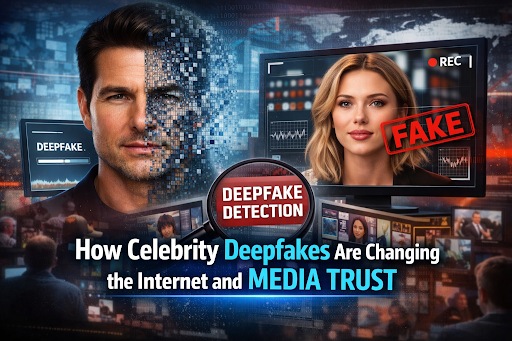
The development of celebrity-faked deepfakes is there as it is one of the most alarming trends in the online media in the era of artificial intelligence and machine learning. Celeb deepfakes are computer-generated video or image content which gives the impression of being an actual image or video of a well-known individual, usually with them being depicted in a situation they never participated in. Although there are harmless applications of this technology, there are high chances of its abuse that can affect privacy, reputation, and trust of the people. With the growing complexity of these technologies, the nature of the dangers posed by celebrity deepfakes and ways to avoid and understand them has been a priority of both users and websites.
The Deepfakes of a Celebrity
Deepfakes of celebrities involve artificial intelligence to create ultra-realistic videos and images or audio of celebrities. Such works frequently apply generative adversarial networks (GANs) and comparable deep learning algorithms to create media that may be indistinguishable to actual video. These tools are capable of imitating faces and voice accents, even minor movements, unlike the traditional photo or video manipulation, which makes the detection more challenging.
Fake celebrity pictures are twice as attractive. On the one hand, they demonstrate the power of AI and provide entertainment, i.e., digital acts in films or recreation of historic events. Conversely, they could be used to commit evil acts such as defaming, misinformation and financial frauds. These risks are heightened by the proliferation of the distribution of distorted information in social media where videos can become viral before the authenticity of the information can be ascertained.
Associated risks with Celeb Deepfakes
Celeb deepfakes 2026 pose risks of many different kinds. To begin with, there is the danger of individual privacy. Celebrities, just like any other person, have a right to manage the usage of their image. Deepfakes portraying people in suggestive or dishonest situations may have significant impact on personal and professional life.
Secondly, there is the reputational risk. Whoever does not consider themselves a figure of authority, their image, and credibility are at stake, and even a convincing deepfake will break their reputation almost immediately. Contrary to the conventional manipulation of media, in most cases, the reality of the AI-created content prevents the audience from distinguishing truth and fabrication. The other major issue is misinformation. Celeb deepfakes may be used to work out the majority opinion or cause political chaos, or fake stories. An example of this is counterfeit statements or behaviors made to seem to be done by a celebrity, which would influence millions of people in real-life social and economic terms.
Lastly, the deepfakes can be monetized using scams. Hackers can come up with videos of celebrities promoting products or services and deceive fans to invest money in their illegal activities. This is a powerful weapon of deception because of the believability and the possibility of being spread as a virus.
Deepfake Detection Role
Celebrity deep fakes are increasingly becoming sophisticated, and deepfake detection is becoming increasingly critical. A deepfake detector is a technological system that is made to detect edited media, usually in real time. These are tools that identify anomalies in the movement of the face, lighting, textures, and sounds to identify whether the content is artificial.
Methods of Deepfake detection are different according to the type of media. Frame-by-frame analysis can be used in the video analysis of motion artifacts or pixel artifacts. Voice pattern and intonation detection algorithms are used to find irregularities that signify artificial manipulation. Most contemporary systems are using a combination of several methods to maximize detection.
The detection tools are vital to the protection of the image and the personal safety of the people in the case of celebrities. User-generated content platforms (social media, video-sharing sites) can incorporate the deepfake detection software and automatically label suspicious content prior to spreading. Such a proactive strategy decreases the chances of the misinformation of the virus and minimizes possible harm.
The Detection Technological Advancements
The growth of deepfake detection software has grown fast with the complexity of the AI-generated images. Prescient detection strategies were based on simple visual features, including a blanking or irregular facial features. Although they are effective at fighting against more basic deepfakes, they cannot compete with more advanced artificial intelligence models that can fake the appearance of these characteristics in such a way that they seem authentic.
The current day deepfake detectors use sophisticated machine learning frameworks that analyze various aspects of media. Convolutional neural networks are used to identify fine-scale spatial irregularities of pictures, and temporal analysis of micro-expressions and movements with time. Algorithms of audio analysis may match the voice features with the known samples, revealing synthetic manipulations even in the case the video itself seems natural. Also, hybrid detection systems are on the rise, that is, they will combine visual and auditory analysis together with contextual checks. As an example, metadata checks and cross-platform checks may aid in identifying whether a video is consistent with the verified sources, providing the additional level of questioning. The multi-layered solution is becoming more and more crucial in the environment where AI based content keeps gaining on realism.
Legal and Ethical Concerns
The legal and ethical challenges complexities about celebrity deepfakes proliferation are numerous. In most jurisdictions, today, there exists little legal redress in cases involving the victims of AI-generated information. There might be defamation, privacy and intellectual property laws that come into play although they are usually able to keep up with technology changes. Content creators and platform operators have the ethical responsibility of ensuring that they prevent misuse. The distribution and production of falsified material without authorization might have physical effects such as harassment, mental disturbance and financial loss. It is essential to create a set of rules to regulate the content covered in the news and the ethical application of AI-generated media to ensure the safety of both public personalities and the general population.
There are organizations, which insist on the legislation as the specific legislation on deepfake technology. These regulations may oblige the platforms to reveal displaced material, introduce effective detection devices, and punish bad actors. As policy development continues, the most effective protection is offered today with the help of technological solutions.
Community Education and Raising of Awareness
Besides the detection technology the public awareness has a critical role in alleviating the effects of celeb deepfakes. Teaching the audiences about the reality and possible harm of AI-generated content can make people view the media with a skeptical mind. Realizing that not every video or image is original helps to decrease the spread of misinformation and promote good sharing.
In the case of celebrities, it is concerned with their own digital image. By using Online Monitoring of the content that includes their likeness and actively reporting deepfakes can minimize exposure as well as safeguard personal and professional reputations. These are reinforced by partnering with platforms, legal professionals and technology providers.
Uses Media, Entertainment
Deepfakes of celebrities are not necessarily bad, and they have their valid purposes when applied reasonably. They can reproduce acts in the entertainment sector, they can make historical events live in a documentary or they can make actors appear on a screen without having to be physically present. These applications, however, should be approved, and it should be observed that the ethical standards are observed closely.
Another area that can be used is advertising and virtual appearances. The AI-generated pictures of celebrities can be utilized by the brands, and only with permission. Ethical use will allow deepfake technology to increase creativity with no violation of personal rights as well as manipulation of the audience.
Difficulties in Regulating Deepfakes by celebrities
Although there has been progress in detecting and educating the population, there are still challenges. The rate at which information is disseminated via the internet in most cases beats moderation. A compelling deepfake will spread to millions of people in hours before detection software picks it up. Also, the creators of deepfakes continuously enhance the methods, and it becomes more difficult to detect them because of the detection tools.
Another factor is global accessibility. The information stored on decentralized systems, messaging applications, or local servers can not be detected at all. The problem of ensuring a broad coverage of the digital spectrum is a complicated task that involves platforms, governments, and technological providers.
Last but not least, there is still an issue of false positives. The detection algorithms can report on legitimate content, which affects content creators and celebrities. There is a need to balance sensitivity and accuracy so that trust in the technology and platforms implementing the same are held. Get comprehensive data extraction solutions per your requirements, create a competitive edge in the market, and enhance customer satisfaction.
The Future of Deepfake Protection of Celebrities
By the next decade, possibly later in 2026, mitigating digital manipulation of celebrities will entail both technology and policy alongside the engagement of the populace. Deepfake detection will also develop, and AI will be able to improve to detect more realistic synthetic media. It will be necessary to integrate across platforms and industries to establish a unified defense.
Ethical codes and laws will be used complementarily to provide rules that consent, disclosure and accountability. Critical media literacy will be reinforced through education campaigns to help the audiences be aware and responsive to the manipulated information. But at the end of it all is the desire to make AI innovation prosper without interfering with the rights, privacy, and reputation of people. The proper use of deepfake detection technology will guarantee both creativity and security exist in the digital age.
Also Read: The Role of AI in Identity Verification and Fraud Detection
Conclusion
Celebrity deepfakes are not only evidence of the incredible potential of artificial intelligence in contemporary media, but also embodiments of the dangers of such technology. Though they can be employed in the name of entertainment and innovation, their abuse poses a threat to privacy, reputation and trust of the people. The strategies that should be implemented to curb these risks include integrating deepfake detection tools, implementation of ethical rules, and creation of awareness among the people.
The use of deepfake detectors and sophisticated detection software creates a technological barrier and allows verifying the content in real-time and safeguarding people against misinformation and fraud. With AI still developing, the protection of celebrities against digital manipulation will be a burning issue, as the internet media will not lose its authenticity, reliability, and its attitude to the rights of people.