

For manufacturing companies, software decisions have started carrying a lot more operational weight than they did a few years ago.
Back then, most ERP discussions were centered around moving businesses away from manual processes. Companies wanted to stop relying on spreadsheets, keep all their reporting in one place, and have a clearer view of procurement, inventory, and production activities. That was the priority.
Now the pressure is different.
Manufacturing today is far from smooth. Supply chains keep shifting, production gets delayed, and different plants often run on systems that don’t really talk to each other. On top of that, there’s constant pressure to do more with less, better efficiency, but without increasing costs. In that kind of setup, software is no longer just an IT line item. It directly affects how smoothly the business runs day to day.
That’s why more manufacturers are reconsidering a question that used to have a fairly predictable answer:
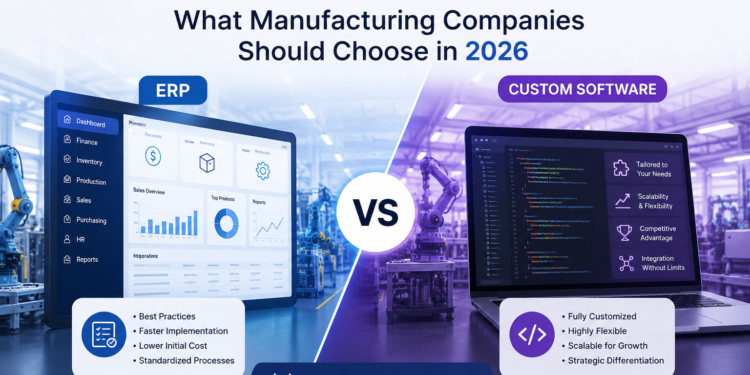
Should the company continue with a traditional ERP setup, or build software around its own operational processes?
The answer depends less on company size and more on how complex the operation has become.
Why ERP Systems Still Make Sense for Many Manufacturers
There’s a reason ERP platforms remain deeply embedded in manufacturing operations.
A mature ERP system for manufacturing industry environments already handles many critical functions reasonably well:
- inventory tracking
- procurement management
- production scheduling
- warehouse coordination
- finance and reporting
For manufacturers running standardized operations, ERP systems still provide structure that would otherwise take years to build internally.
That operational consistency matters more than people sometimes admit.
Once multiple departments start using disconnected systems, small inefficiencies compound quickly. Procurement data doesn’t match inventory. Production teams rely on outdated numbers. Reporting becomes delayed or unreliable.
ERP platforms solve much of that by centralizing operational information into a single environment.
For many businesses, that alone justifies the investment.
The Friction Starts When Workflows Become Too Specific
The problem usually appears when manufacturing workflows stop fitting neatly into standard ERP structures.
Most factories evolve over time. Processes become highly specific to production methods, supplier relationships, regional compliance requirements, or internal approval systems. Eventually, operations start looking very different from the workflow assumptions built into commercial ERP platforms.
That’s where companies begin running into friction.
Some businesses try adapting their operations around the ERP itself. Others spend years customizing the platform until upgrades become difficult and maintenance costs increase.
Neither approach is particularly efficient long term.
In reality, many operational bottlenecks sit in the gaps between departments rather than inside individual processes. Traditional ERP systems are good at standardization, but they’re often less flexible when workflows become unusually specific.
That’s one reason demand for custom ERP software development has increased steadily across manufacturing environments.
Custom Software Gives Manufacturers More Operational Control
Custom software changes the conversation entirely because the system is designed around the business rather than the other way around.
For some manufacturers, that flexibility matters a great deal.
A company may need:
- plant-level production logic
- highly specific inventory workflows
- integration with older machinery
- custom reporting structures
- supplier approval processes unique to a particular region
Trying to force those workflows into rigid ERP templates often creates operational slowdowns over time.
Custom platforms allow businesses to build around the way production already works instead of redesigning operations purely to satisfy software limitations.
That becomes especially useful for manufacturers operating across multiple facilities where workflows vary slightly between locations.
But Custom Software Isn’t Automatically Easier
A lot of companies underestimate this part.
Custom systems provide flexibility, but they also introduce responsibility.
ERP vendors already handle many things behind the scenes:
- infrastructure stability
- compliance updates
- version management
- security maintenance
- standardized integrations
With custom platforms, much of that responsibility shifts back to the business or the development partner managing the system.
That’s why architecture planning matters early. If the software foundation is weak, scaling becomes expensive later.
In many failed manufacturing software projects, the issue isn’t the technology itself. It’s poor planning at the beginning, unclear workflows, rushed requirements, or systems built without long-term operational growth in mind.
More Manufacturers Are Combining ERP and Custom Systems
Interestingly, many manufacturers are no longer treating this as an either-or decision.
A more common approach in 2026 looks like this:
- ERP handles finance, procurement, and inventory
- custom software manages production operations, analytics, plant workflows, or integrations
This hybrid structure gives companies stability where standardization matters while still allowing flexibility inside operational areas that evolve frequently.
For many manufacturers, that balance makes more sense than replacing everything outright.
The Real Decision Comes Down to Operational Complexity
The companies that benefit most from traditional ERP systems are usually the ones with relatively stable workflows and fewer operational variations between departments.
Manufacturers leaning toward custom development tend to have:
- specialized production environments
- multiple disconnected systems
- evolving operational requirements
- complex reporting structures
- heavy integration dependencies
At that point, flexibility starts becoming more valuable than standardization alone.
Manufacturing Software Decisions Are Becoming Long-Term Infrastructure Decisions
One thing has become increasingly clear across the manufacturing sector: software decisions now shape operational flexibility for years.
Companies are no longer evaluating systems based only on current requirements. They’re asking harder questions:
- Will this system adapt as workflows change?
- How difficult will integrations become later?
- Will production teams outgrow the platform within a few years?
That shift is changing how manufacturers approach technology investments altogether.
Development teams working in manufacturing environments, including firms such as Colan Infotech—are increasingly seeing businesses move toward modular architectures instead of fully rigid ERP ecosystems.
The broader reason is simple. Manufacturing operations rarely stay static for long. Software that cannot evolve alongside operational changes eventually becomes another bottleneck the business has to work around.